

Privacy vs Security: Protecting Data Isn’t the Same as Respecting It
For years, consumer brands have reassured customers with a familiar promise: your data is safe with us. It’s a comforting message. It signals competence, control, and technical rigour. Firewalls are in place. Encryption is working. Breaches are, hopefully, rare.
But increasingly, that promise is falling short of what consumers actually expect. That’s because in todays B2C landscape, keeping data safe is no longer the same as treating it fairly. And this is where many organisations quietly lose trust—not through failure, but through misunderstanding.
The mistake is subtle, but consequential: assuming that security delivers privacy.
It doesn’t.
The Illusion of Protection
At a glance, privacy and security appear inseparable. Both deal with data. Both mitigate risk. Both sit somewhere between compliance and technology. But they operate on entirely different principles.
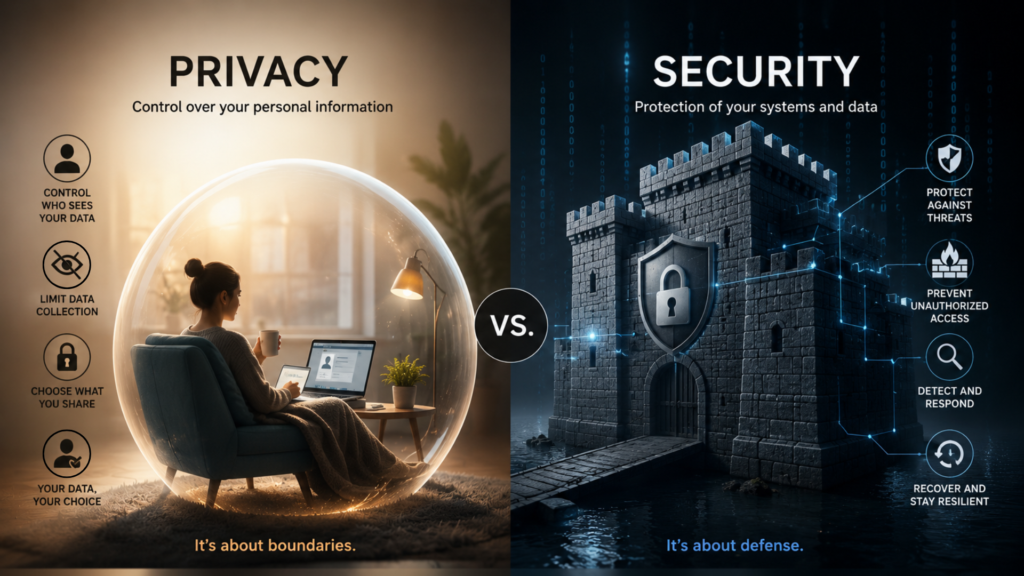
Security is about defence. It protects information from unauthorised access like hackers, breaches, system failures. It is, in essence, a technical discipline.
Privacy, on the other hand, is about judgement. It governs what data is collected, why it is collected, and whether it should exist in the first place. It is as much about ethics and trust as it is about regulation. [okta.com]
This distinction matters more in B2C than anywhere else because unlike enterprise data, consumer data is personal, it reflects identity, behaviour, and intent.Consumers now care about more than whether their data is being protected. They care whether it is being used in ways that feel appropriate.
When Secure Feels Invasivey
Let’s consider the modern retail or digital platform experience. A customer browses a product, hesitates, and moves on. Minutes later, that exact product follows them across social media, email, and display advertising.
From a security perspective, nothing has gone wrong. The data has not been breached, leaked, or stolen. Systems are functioning exactly as designed. But from a privacy perspective, something feels off.
The company may have done everything necessary to secure the data, but the issue isn’t about exposure, it’s about expectation. The system knows more, does more, and persists longer than the customer anticipated.This is the defining tension in the B2C world today: data can be perfectly secure and still profoundly uncomfortable. And that discomfort is what erodes trust.
The Opposite Problem: Good Intentions, Weak Protection
Of course, the inverse plays out too. Many brands invest heavily in privacy language; clearer policies, consent banners, preference centres etc. On the surface, this reflects a more respectful approach to data.
But when those commitments sit on top of fragile infrastructure or inconsistent controls, they unravel quickly. A breach doesn’t just expose data, it exposes reliability and reputation. It signals that a brand promised control, but failed to uphold it.
This is the reality: privacy without security is aspirational. Security without privacy is transactional. Neither is sufficient on its own.
Why B2C Brands Get This Wrong
So what’s behind this confusion? What’s driving the misconception of these practices and the disconnect of their application?
First, security is easier to buy. There are vendors, tools, dashboards—visible investments that signal progress. Privacy, by contrast, demands restraint. It asks uncomfortable questions: do we really need this data? Should we be doing this at all?
Second, incentives are misaligned. In B2C, data fuels growth—personalisation, targeting, optimisation. The more data collected, the more powerful the model. Privacy, inevitably, places limits on that ambition. (maybe it doesn’t have to)
And third, ownership is fragmented. Security sits with IT or cyber teams. Privacy sits with legal or compliance. The customer experience sits somewhere elsewhere entirely. What emerges is a gap—not in capability, but in coherence.
A More Useful Lens: Power and Permission
For B2C organisations, reframing privacy vs security is about recognising the distinct questions that each answers:
Security answers: Can others access this data?
Privacy answers: Should we have this data at all?
One protects against external threats. The other governs internal behaviour.
Consumers are becoming far more attuned to the latter. They increasingly accept that data fuels modern experiences such as personalisation, convenience and relevance which all depend on it. But that acceptance is conditional.
It depends on three expectations:
- Transparency: understanding what is being collected and why
- Proportionality: data collection that feels appropriate to the service
- Control: the ability to influence how that data is used
Security underpins these expectations but on it’s own it cannot satisfy them.
Trust Is Built in the Gap
The brands that are getting this right aren’t necessarily collecting less data. Nor are they purely “more secure”. But they are clearer about the boundaries.
They design experiences that align with customer expectations, not just technical capability. They recognise that just because data can be used doesn’t mean it should be.Crucially, they understand that trust is built in the space between what is possible and what is appropriate.
Final Thought
For B2C organisations, the implication is straightforward but uncomfortable: You cannot engineer your way to privacy.
You can secure systems. You can harden infrastructure. You can reduce breach risk to near zero. Yet despite all this you can still lose customers, because privacy is not about protection alone, but about restraint.
Security will always be a baseline. But privacy is what differentiates.It is a clear message to customers that a brand doesn’t just protect data—it respects it.
In the next phase of digital competition, trust will not be won by the brands that shout loudest about security. It will be won by those that demonstrate judgement.
Because in the eyes of the consumer, the question is no longer: “Is my data safe?”
It’s: “Do you deserve to have it?”
Find out how InAcademia can support your businesses efforts to respect data here.